
Attestation
This section outlines the types of attestation (both node and workload) that Cofide Connect supports.
Node Attestation
Section titled “Node Attestation”The following node attestation methods are currently supported in Connect:
Kubernetes
Section titled “Kubernetes”The k8s_psat (Kubernetes Projected Service Account Token) plugin attests nodes running inside Kubernetes clusters. The Cofide SPIRE agent presents a signed projected service account token mounted on the node, which the server validates against the Kubernetes API. This is the recommended attestation method for Kubernetes workloads.
SPIFFE ID format: spiffe://trust-domain/spire/agent/k8s_psat/CLUSTER/NODE_UID
Cloud Providers
Section titled “Cloud Providers”Cofide SPIRE supports the OSS implementations of attestors for each of the major cloud providers, allowing for platform-issued tokens and metadata to be used to verify the identity of a VM scheduled on public cloud.
| Plugin | Platform | SPIFFE ID format |
|---|---|---|
aws_iid | Amazon Web Services | spiffe://trust-domain/spire/agent/aws_iid/ACCOUNT_ID/REGION/INSTANCE_ID |
azure_msi | Microsoft Azure | spiffe://trust-domain/spire/agent/azure_msi/TENANT_ID/PRINCIPAL_ID |
gcp_iit | Google Cloud Platform | spiffe://trust-domain/spire/agent/gcp_iit/PROJECT_ID/INSTANCE_ID |
TPM Attestation
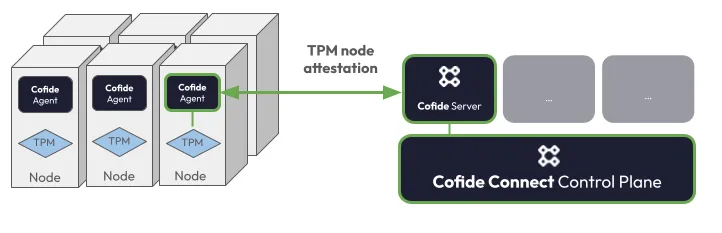
Section titled “TPM Attestation”Trusted Platform Module (TPM) attestation provides hardware-rooted node identity, suitable for environments where strong cryptographic proof of node identity is required without an orchestration- or platform-layer. Common use cases include bare-metal, edge, and IoT deployments.
How it works
Section titled “How it works”TPM attestation relies on two cryptographic keys that the TPM manages:
- Endorsement Key (EK): a keypair provisioned on the chip during manufacture. The private EK never leaves the TPM: only the public EK is shared. It serves as the hardware’s permanent, immutable identity.
- Attestation Key (AK) : a temporary keypair generated on-demand inside the TPM by the Cofide SPIRE Agent at the start of each attestation cycle.
Attestation proceeds in three phases:
-
Key generation: The Cofide SPIRE Agent generates a fresh AK within the TPM and sends both the public AK and public EK to the Cofide SPIRE Server.
-
Challenge (
MakeCredential): The Cofide SPIRE Server looks up the public EK hash against the Attestation Policies registered in the Connect control plane for the given Trust Zone. If a matching policy exists, the Cofide SPIRE Server uses the public EK to encrypt a secret nonce and mathematically binds the encrypted package to the public AK. This bound package is then returned to the Cofide SPIRE Agent. -
Response (
ActivateCredential): The Cofide SPIRE Agent passes the encrypted package to the TPM. To recover the nonce, the TPM must use both its private EK and private AK to decrypt the message. Successful recovery provides two guarantees: the hardware is genuine (only the true TPM holds the private EK), and the AK is bound to that specific node. The decrypted secret is returned to the Cofide SPIRE Server, which verifies it matches the original.
Once the nonce is verified, the Cofide SPIRE Server issues the node its SVID with the selector values defined in the matching Attestation Policy.
SPIFFE ID format: spiffe://trust-domain/spire/agent/tpm/EK_HASH
Workload Attestation
Section titled “Workload Attestation”Workload attestation determines the identity of individual processes or containers on an already-attested node. These plugins run on the Cofide SPIRE Agent and interrogate the local runtime to produce selectors. More details on the upstream implementation of workload attestors can be found in the SPIRE documentation.
| Plugin | Runtime | Example selectors |
|---|---|---|
k8s | Kubernetes (via kubelet) | Namespace, pod name/UID, service account, container image, pod labels, node name |
unix | Unix processes | UID, GID, username, group, binary path, SHA256 hash |
docker | Docker containers | Container labels, image name |
systemd | systemd units | Unit name, slice |
windows | Windows processes | User SID, path |
Workload selectors are combined with Attestation Policies to determine which SPIFFE ID a workload is issued. See Attestation Policies for more.
Connect Attestation Policies
Section titled “Connect Attestation Policies”As discussed in Concepts, an Attestation Policy maps a set of (node or workload) selectors provided by an attestor plugin to a SPIFFE ID, meaning that any workload which satisfies all of the selectors will be issued the corresponding identity document by SPIRE.
In Cofide Connect, there are three types of attestation policy:
Static Attestation Policies
Section titled “Static Attestation Policies”Static attestation policies (APs) are the simplest class of AP in Connect. They map a static set of node or workload selectors to a fixed SPIFFE ID string with a particular parent SPIFFE ID. These policies are equivalent to SPIRE registration entries, assigned to a single trust zone.
See the Connect API reference for more details.
Kubernetes Attestation Policies
Section titled “Kubernetes Attestation Policies”Kubernetes APs allow for a more dynamic configuration of workload attestation policies than the static equivalent. These policies require the Cofide Observer component to be installed on the workload Kubernetes cluster.
Instead of mapping directly onto SPIRE registration entries, these policies can use observed workload properties to dynamically create SPIRE registration entries. For example, creating a policy with
cofidectl attestation-policy add kubernetes --name foo --namespace bar --trust-zone my-trust-zonewould enable any workload in namespace bar to be granted the SPIFFE ID spiffe://<trust-domain>/cluster/<cluster-name>/ns/bar/sa/<workload-service-account-name>.
It is also possible to customize the SPIFFE ID template granted to workloads which match Kubernetes APs by providing a Go template string to the --spiffeid-path-template argument. Valid template components are:
.ClusterName.PodMeta.Namespaceindex .PodMeta.Labels “key”- Pod label value of a provided keyindex .PodMeta.Annotations “key”- Pod annotation value of a provided key.PodSpec.ServiceAccountName
The default SPIFFE ID path template is <trust-domain>/cluster/{{ .ClusterName }}/ns/{{ .PodMeta.Namespace }}/sa/{{ .PodSpec.ServiceAccountName }}.
For more details on Kubernetes APs, see cofidectl attestation-policy add kubernetes -h or the Connect API reference.
Choosing between static and Kubernetes attestation policies
Section titled “Choosing between static and Kubernetes attestation policies”For Kubernetes workloads, static and Kubernetes APs can often achieve equivalent results, and understanding the trade-offs helps you choose the right type.
Use a static AP when:
- You do not want to install the Cofide Observer on the workload cluster.
- You want identity to be available immediately when a pod starts. Because the SPIRE registration entry for a static AP is created when the policy is assigned to a trust zone — not reactively when a pod is observed — there is no startup delay; a pod can attest as soon as it is scheduled. Kubernetes APs depend on the Cofide Observer to report pod observations to Connect before the corresponding SPIRE registration entries are created.
- The SPIRE selectors you need are expressive enough to target the right workloads. You can combine selectors such as
k8s:ns:<namespace>,k8s:sa:<service-account>, andk8s:pod-label:<key>:<value>to scope an identity as broadly or narrowly as required, from all pods in a namespace down to a specific labelled workload.
Use a Kubernetes AP when:
- You want a single policy to cover multiple different workloads with distinct identities. Because the SPIFFE ID path is a Go template rendered per observed pod, one Kubernetes AP can dynamically issue different SPIFFE IDs to pods across multiple namespaces or service accounts — without requiring a separate policy per workload. A static AP with a fixed SPIFFE ID path can only represent a single identity, so covering N distinct workloads requires N separate static APs.
- You want Connect to maintain awareness (via the Cofide Observer) of which pods currently hold identities, for auditing or event-driven workflows.
TPM Node Attestation Policies
Section titled “TPM Node Attestation Policies”Trusted Platform Module (TPM) attestation policies are a Connect-native policy resource for onboarding bare-metal nodes into the Connect platform. For background see the above TPM attestation section or for more details on creating TPM policies in Connect, see cofidectl attestation-policy add tpm-node -h
© 2026 Cofide Limited. All rights reserved.